High-Intensity Exercise Triggers a Far Larger Molecular Response Than Moderate Exercise. Five Minutes of Sprints Changed 714 Blood Proteins to Moderate Cycling's 7
Prefer to listen? Hit play for a conversational, audio‑style summary of this article’s key points.
Exercise works largely by flooding your blood with signaling molecules, and intensity determines how big that flood is. When you exercise, your muscles and other tissues release proteins and metabolites into the bloodstream that travel to distant organs and change how they behave. A new study in Cell Reports Medicine found that the intensity of exercise, far more than its duration, drives the size of this molecular response.
A few minutes of sprints produced a vastly larger protein response than ninety minutes of moderate cycling. Researchers tracked nearly 3,000 blood proteins before, immediately after, and 3 hours following each workout in young, healthy men. Sprint intervals, under five minutes of actual hard work, altered 714 proteins immediately after exercise. Ninety minutes of moderate cycling altered 7. More than 98% of the sprint-driven changes were increases, a coordinated surge rather than a scattered shift.
The muscle itself releases signals in proportion to how hard it works. When researchers electrically stimulated isolated human muscle cells to mimic each workout, the simulated-sprint pattern released 212 proteins while the simulated-moderate pattern released 9. The intensity dependence was built into the muscle cell, tied to stronger activation of AMPK, a cellular energy sensor that responds to demand.
Intense-exercise blood signals reprogrammed fat tissue on a massive scale. When human fat cells were bathed in plasma drawn after each workout, sprint plasma changed the activity of 1,128 genes; moderate plasma changed 25. The changes activated pathways for hormone response, nutrient sensing, and fat breakdown, and 418 of them were confirmed in real biopsied fat tissue after exercise, showing the effect is genuine, not an artifact of cultured cells.
The signals appear to reach organs across the body, not just muscle and fat. By matching released proteins to the organs that make them and the organs rich in their receptors, researchers predicted intensity-dependent signals directed at the brain, immune cells, adrenal glands, gut, and kidney. These organ-to-organ links are computational predictions rather than direct observations, but they suggest intense exercise coordinates a genuinely body-wide response.
Exercise metabolites told the same intensity story. Sprint exercise immediately raised lactate, pyruvate, malate, and Lac-Phe, an appetite-suppressing, obesity-mitigating molecule produced more by intense exercise. Moderate exercise's main metabolic signature, a rise in fatty acids, appeared later, around the 3-hour mark, reflecting its slower shift toward burning fat.
The signals intense exercise released were disproportionately the ones linked to health. Cross-referencing exercise-responsive proteins against a database of 53,026 people's blood and disease outcomes, researchers found 143 exercise proteins associated with lower disease risk. Of the 33 most specifically protective against type 2 diabetes, obesity, and metabolic disorders, sprint exercise raised 32; moderate exercise raised 3.
This is not an argument against moderate exercise, which does things sprints cannot. Moderate exercise uniquely raised liver-derived proteins like IGFBP1 and follistatin, reflecting the sustained energy demand of longer effort. Intensity and duration are distinct stimuli that trigger different adaptive programs. The honest takeaway is that they are complementary, with intensity delivering a disproportionate share of protective signaling per minute spent.
The intensity-dependent pattern persisted after training. After 8 weeks of regular exercise, participants repeating the tests still showed the same intensity-driven differences, with proteins like growth hormone, von Willebrand factor, and POMC rising more after sprints. This suggests the effect reflects relative intensity itself, not simply being untrained.
The findings are real but bounded, and their deepest lesson is about measurement. The study was small, in young, healthy, mostly male participants; the organ-crosstalk map is predicted rather than proven; the disease links are associations, not proof of cause; and it measured acute responses, not long-term outcomes. But the whole study rests on a striking premise: your body's physiological state and its trajectory toward health or disease are now readable in remarkable detail from the proteins in a tube of blood. Reading your own, and tracking it over time, is how population-level averages become personal.
Five Minutes of Work That Outsignals Ninety
Here is a puzzle that has quietly troubled exercise science for years. A sprint-interval workout can involve less than five minutes of actual hard effort, a handful of all-out bursts with rest in between, and yet it produces metabolic benefits that rival, and by some measures exceed, an hour and a half of steady moderate cycling. On its face, this makes little sense. If exercise benefits came simply from the total work performed, or the calories burned, or the minutes logged, then ninety minutes should decisively beat five. It does not. Something about intensity itself seems to matter, in a way that duration cannot fully explain.
For a long time, the reason was a black box. We could measure that brief intense exercise worked, but not why a few minutes of it could reshape the body's metabolism as powerfully as it does. The benefit was real and repeatable, and its mechanism was largely invisible.
A new study from Rockefeller University, published in Cell Reports Medicine, opens that box, and what it finds is that the answer is written in the blood. When you exercise, your working muscles and other tissues release a flood of signaling molecules into the bloodstream, proteins and metabolites that travel to distant organs and tell them how to respond. This chemical conversation between organs is one of the main ways exercise remakes the body. And the central finding of this study is that the intensity of exercise, far more than its duration, determines how loud and how far-reaching that conversation is.
The researchers compared two workouts head to head. One was sprint-interval exercise: six thirty-second bursts of all-out cycling, separated by four-minute rests, well under five minutes of genuine work. The other was moderate-intensity exercise: ninety minutes of continuous, comfortable cycling. Then they did something that earlier studies had not done at this scale. They tracked nearly three thousand proteins in the participants' blood, before exercise, immediately after, and three hours later, and followed the signals into the tissues that produce and receive them.
The gap between the two workouts was not subtle. Immediately after exercise, the sprint intervals had altered the levels of 714 proteins in the blood. The ninety-minute moderate session had altered 7. That is not a modest difference in degree; it is a different order of response entirely, from a fraction of the time spent exercising. And when the researchers traced those signals outward, to the fat cells they remodeled, the organs they reached, and the disease risks they tracked with, the same pattern held at every step: intensity, not duration, was driving the body-wide response.
What follows is how a few minutes of hard effort can speak more loudly to the body than an hour and a half of moderate work, which organs are doing the talking, and why the specific signals released by intense exercise turn out to be the ones most closely tied to protection from metabolic disease. It is not that moderate exercise fails to do anything, as we will see, it does things intense exercise does not. But it does raise a real question about whether, when time is short, brief and hard may be the more efficient way to change the body.
Your Organs Talk to Each Other, and Exercise Is the Conversation
To understand what this study measured, you have to abandon a common picture of what exercise does. Most people imagine exercise acting locally: you work a muscle, the muscle gets stronger; you tax your heart, the heart adapts. That happens, but it is a small part of the story. The larger and stranger truth is that exercise is a whole-body chemical event, and much of its benefit comes from organs that never did any of the work.
The body's tissues are in constant communication with one another, and one of their main channels is the bloodstream. Cells release signaling molecules into the blood, where they circulate to distant organs and dock onto receptors that change how those organs behave. Think of the bloodstream as a communication highway running between every tissue in the body, carrying messages from senders to receivers. At rest, there is a steady baseline of traffic. During exercise, the highway floods.
The molecules exercise releases have a name: exerkines. These are the proteins, peptides, and metabolites that working tissues secrete into the circulation, and they are the actual carriers of many of exercise's benefits. When a contracting muscle releases an exerkine that travels to fat tissue and tells it to release stored energy, or to the brain and supports the growth of new neurons, or to the immune system and tunes inflammation, that is exercise working through the highway rather than at the muscle itself. The collective set of these secreted signals is called the secretome, and it is, in a real sense, the body's exercise response translated into chemical language.
This reframes the central question of the study. If exercise works largely by flooding the bloodstream with beneficial signals, then a natural way to ask "what kind of exercise is best" is to ask "what kind of exercise produces the richest, most beneficial flood of signals." Not which workout burns the most calories or lasts the longest, but which one generates the most powerful conversation between organs. That is a question you can now actually answer, because the technology exists to read the highway's traffic directly.
That technology is proteomics: the ability to measure thousands of distinct proteins in a small sample of blood at once. Where an older study might have measured a handful of known exercise signals, this one used a platform that detected and quantified nearly three thousand proteins simultaneously, in more than a hundred blood samples, capturing signals present at vanishingly small concentrations. Alongside it, the researchers measured the blood's metabolites, the small molecules of energy and signaling, giving a second readout of the same conversation. For the first time, they could photograph the entire flood of exercise signals, not just a few droplets of it, and compare what two very different workouts released into the blood.
What they found is that the two workouts were not speaking at different volumes of the same message. They were, to a striking degree, having different conversations.
Two Workouts, Two Different Floods
The comparison at the heart of the study was deliberately lopsided in favor of duration, which makes its result all the more striking. On one side, sprint-interval exercise: six thirty-second bursts of all-out cycling, with four-minute rests between them, amounting to just three minutes of actual hard work and under five minutes counting everything. On the other, moderate-intensity exercise: ninety minutes of continuous cycling at a comfortable, sustainable pace. The participants were young, active, metabolically healthy men, and each type of exercise had its blood sampled at three moments: at rest, immediately after finishing, and three hours later.
The immediate aftermath is where the two workouts diverged most dramatically. Sprint intervals altered the levels of 714 proteins in the blood the moment exercise ended, close to a quarter of every protein the platform could detect. The ninety-minute moderate session altered 7. Not seven hundred, seven. A workout involving perhaps a twentieth of the total exercise time produced roughly a hundred times the immediate protein response.
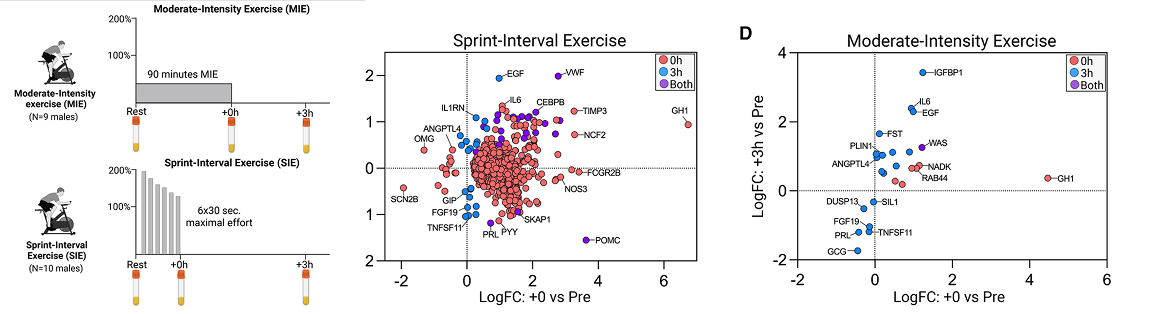
The direction of those changes matters as much as their number. More than 98 percent of the 714 proteins sprint exercise moved went up, not down. This was not a scattered reshuffling of the blood's contents; it was a coordinated surge, a mass release of signals into the circulation all at once. Among them were well-known exercise-response proteins, factors involved in growing new blood vessels, remodeling tissue, and signaling to the gut and brain. The highway did not just get busier. It filled, almost entirely, with outbound traffic.
The sprint response was also fast, in both its onset and its clearance. The flood appeared immediately after exercise and then largely receded: by three hours later, the number of altered proteins had fallen roughly twentyfold. This is a signal designed to spike and resolve, a sharp pulse of communication rather than a lingering shift. Moderate exercise, by contrast, showed the opposite timing. Its handful of changes was slightly larger at the three-hour mark than immediately after, 19 proteins versus 7, a slower, more delayed response that trickled rather than surged.
That timing difference is a clue the article will return to, because it hints that the two workouts are not merely strong and weak versions of the same thing. They operate on different schedules, and, as later experiments showed, through partly different organs. But the headline is the raw asymmetry of the immediate response. By the most direct available measure of how much exercise stirs the body's chemical communication, a few minutes of intense effort did not merely match ninety minutes of moderate work. It exceeded it by two orders of magnitude.
One important check belongs here, because a skeptic would raise it immediately. Intense exercise shifts fluid out of the bloodstream, which concentrates whatever remains and could, in principle, make protein levels look elevated simply because the blood is more concentrated. The researchers corrected for this, adjusting for exercise-induced changes in plasma volume, and the intensity-dependent differences held. They also confirmed the key findings with a second, independent protein-measurement method, which not only reproduced the pattern but detected additional sprint-driven proteins the first platform had missed. The flood is real, not an artifact of concentrated blood.
Where the Signals Come From: The Muscle Speaks First
A flood of proteins in the blood raises an obvious question: where is it all coming from? Knowing that 714 proteins surged tells you the conversation got loud, but not who was talking. Tracing the signals back to their tissues of origin is harder than measuring them, and it is where the study had to combine clever inference with direct experiment.
The inference came first. Different organs express different genes, so a protein made mainly by, say, the liver carries a kind of molecular return address. By cross-referencing the exercise-responsive proteins against large databases of which tissues produce which proteins, the researchers could predict each signal's likely organ of origin. This is prediction, not proof, and the article will keep that distinction visible, but it is well-grounded prediction, and it pointed to a striking breadth of sources. The signals in the blood appeared to originate not just from muscle but from fat tissue, liver, brain, immune cells, the pituitary gland, the pancreas, and more. Exercise was not one organ shouting. It was many organs speaking at once.
Muscle, though, was the obvious lead suspect for the intensity effect, since it does the actual work of exercise, and the researchers went after it directly rather than settling for prediction. They took the tissue that should be most intensity-sensitive and tested whether it really releases proteins in proportion to how hard it works.
To do this cleanly, they turned to isolated muscle cells, which let them separate the muscle's own secretions from everything else happening in an exercising body. They grew muscle cells in a dish and used electrical stimulation to make them contract in patterns mimicking either sprint intervals or moderate exercise, then measured which proteins the cells released into the surrounding fluid. The design has a real strength: whatever the cells secrete has to come from the muscle itself, with no other organs to muddy the picture.
The result mirrored the blood findings precisely. Muscle cells driven with the simulated sprint pattern released 212 proteins into their surroundings. The same cells given the simulated moderate pattern released 9. The intensity dependence was not a whole-body accident of circulation or fluid shifts; it was built into the muscle cell itself. Work the cell harder, and it secretes far more signal, a roughly twentyfold difference from the same cells under a gentler protocol.
The researchers could even see why, at least in part. The sprint-stimulated cells showed elevated activity of AMPK, a cellular energy sensor that switches on when a cell's energy demand is high and its fuel is running low. AMPK is one of the master switches of the exercise response, and its stronger activation under the sprint protocol fits the logic cleanly: a harder-working cell is a more energy-stressed cell, and that stress is part of what drives the secretory flood. The muscle releases more signal when it is pushed closer to its limits.
Two honest caveats keep this in proportion, and the study states both. First, forcing cultured cells to contract intensely can damage them, and damaged cells can spill proteins in ways that inflate the count, so the in-vitro numbers should be read as directional rather than exact. Second, and more interesting, a separate line of research using precise cell-labeling methods has found that surprisingly few muscle-derived proteins actually make it into the general circulation, suggesting some of what muscle secretes may act locally, within the muscle itself, rather than traveling the highway to distant organs. The muscle clearly speaks in an intensity-dependent way. Exactly how much of its message reaches the rest of the body, versus staying local, is not yet settled.
Which is why the study did not stop at the source. To show the conversation actually reaches and changes distant organs, it needed to look at a receiver.
Where the Signals Land: Fat Tissue Listens
If exercise floods the blood with signals, those signals only matter if something on the other end receives them and changes in response. So the researchers turned from the senders to a receiver, and they chose fat tissue, an organ with every reason to be listening.
Fat tissue is not the inert storage depot it was once thought to be. It is metabolically active, hormonally responsive, and central to the diseases exercise protects against, obesity, type 2 diabetes, metabolic syndrome. If exercise's circulating signals reshape metabolism, fat is exactly the kind of tissue you would expect them to reshape. The question was whether it, too, would respond in an intensity-dependent way.
The experiment was elegantly direct. The researchers took human fat cells grown in the lab and bathed them in blood plasma drawn from the study participants after exercise, plasma from sprint sessions on some cells, plasma from moderate sessions on others. Then they read out how the fat cells' gene activity changed in response. Whatever was dissolved in that post-exercise plasma, the actual flood of signals the exercise had produced, was now washing over fat cells, and the cells' reaction would show how powerfully that flood spoke to them.
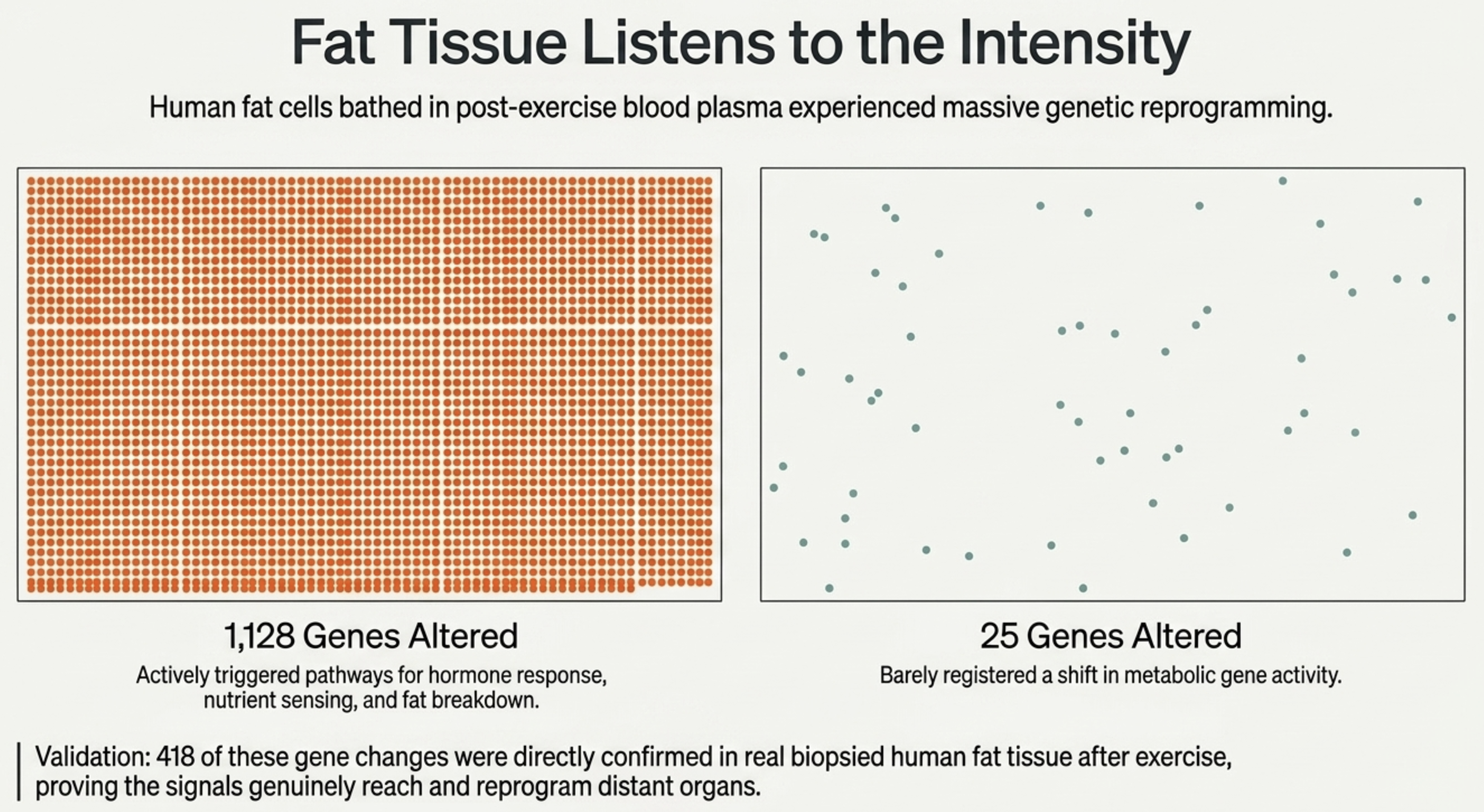
The asymmetry from the blood reappeared, if anything more starkly. Plasma from sprint exercise changed the activity of 1,128 genes in the fat cells. Plasma from moderate exercise changed 25. The signals produced by a few minutes of intense effort reprogrammed fat-cell gene expression on a vast scale, while the signals from ninety minutes of moderate cycling barely moved it. The receiver heard the sprint conversation loud and clear, and all but missed the moderate one.
What the sprint signals told the fat cells to do is as interesting as how many genes they moved. The reprogramming activated pathways governing responses to hormones, the sensing of nutrients, and the breakdown of stored fat, exactly the kind of metabolic shift you would want exercise to produce in fat tissue. Several immune-signaling receptors rose as well, suggesting the exercise plasma was priming the fat to handle inflammatory signals differently. This was not random agitation of the cell's machinery. It was a coordinated push toward a more metabolically active, more responsive state.
The obvious objection is that cells in a dish are not tissue in a body, and the researchers met it. They biopsied abdominal fat from participants before and three hours after a bout of maximal exercise, and looked at which genes changed in the living tissue. Of the genes that intense-exercise plasma had altered in the isolated cells, 418 overlapped with those that changed in real fat tissue after real exercise. The dish was not lying. Circulating factors from intense exercise genuinely reach fat tissue in the body and alter its biology, including genes governing how fat is handled and stored, and the overlap with the plasma experiment confirms those changes are driven by signals in the blood rather than by something happening only in cultured cells.
So the conversation is complete, end to end. Intense exercise drives working tissues to release a flood of signals into the blood; those signals reach fat tissue; and the fat responds by extensively rewiring its metabolic gene activity, far more than moderate exercise's fainter signals can achieve. Sender, highway, receiver. And fat is only one of the organs on the receiving end.
A Body-Wide Conversation
Fat tissue is one receiver, but the study's most expansive claim is that intense exercise opens lines of communication to many organs at once. Reconstructing that full map is where the work becomes most inferential, and it deserves to be read with that in mind, but the picture it produces is remarkable.
To predict which organs were talking to which, the researchers used the molecular return-address logic on both ends of each conversation. A signaling protein has a likely tissue of origin, based on which organ predominantly produces it, and it also has a set of receptors it can dock onto, receptors that are themselves concentrated in particular organs. By matching exercise-released proteins to the organs that make them, and then to the organs rich in the receptors those proteins target, the researchers could predict specific organ-to-organ signaling links: this protein, released from that tissue, is built to send a message to this other one.
The predicted map that emerged from sprint exercise reached across the body. There were signals apparently directed at the brain, including a protein involved in relaxing blood vessels. Signals to immune cells, tuning inflammation up or down. Signals to the adrenal glands, the body's stress-hormone centers. Signals to the intestine and to the kidney. A protein from the pituitary gland involved in the stress response rose sharply. Intense exercise, on this evidence, is not a local transaction between muscle and heart. It is a broadcast, muscle and other tissues sending coordinated messages to organs throughout the body, many of which have nothing to do with the mechanical act of cycling.
And this broadcast was intensity-dependent, like everything else. When the researchers applied the same predictive analysis to moderate exercise, they could not identify these organ-to-organ signaling pairs, largely because moderate exercise moved so few proteins that little survived the analysis's stringent filters. The quiet moderate response simply did not contain enough signal to trace a rich network of organ communication. The body-wide conversation was something intense exercise switched on and moderate exercise, in this dataset, largely did not.
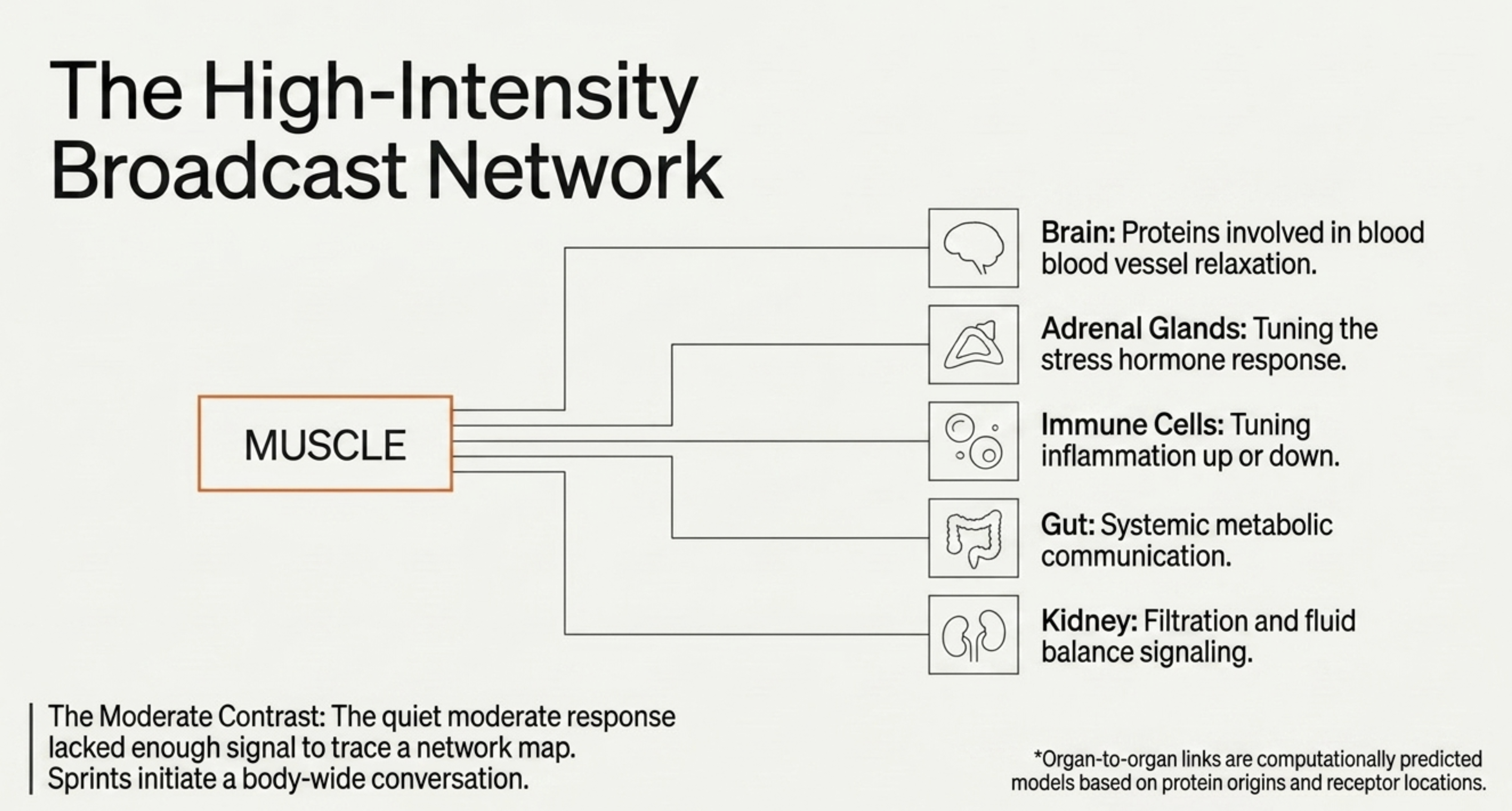
The honesty about method matters here, and the study is careful about it, so the article will be too. These organ-to-organ links are predictions, built from databases of where proteins are made and where their receptors sit, not direct observations of a signal leaving one organ and arriving at another. A predicted conversation is a hypothesis, a well-reasoned one, grounded in real expression data and, for fat tissue, backed up by the direct plasma experiments, but a hypothesis nonetheless. What the study establishes firmly is that intense exercise releases far more organ-targeted signals than moderate exercise does. Precisely which organ is sending which message to which other organ is the map it sketches for future work to confirm.
Even held to that honest standard, the shape of the finding is what matters. The signals released by a few minutes of hard effort are not a monotonous surge of a single message. They are addressed, many of them carrying molecular instructions built to act on specific distant organs, and collectively they suggest that intense exercise coordinates a response spanning much of the body. Which raises the question the whole study has been building toward: if these intensity-dependent signals are so much richer, are they also the ones that matter for health?
The Other Language: Metabolites
Proteins are not the only messages moving on the highway. Alongside them travels a second language, smaller and faster: metabolites, the little molecules of energy and signaling that a working body produces and consumes. The researchers read this language too, measuring the blood's metabolites alongside its proteins, and it told a complementary version of the same story.
Sprint exercise immediately flooded the blood with the metabolic signatures of intense effort. Lactate, the molecule most people associate with muscles burning during hard exercise, rose sharply, along with pyruvate and malate, intermediates of the cell's energy-production machinery running at full tilt. These are the fingerprints of muscles working near their limit, drawing on fast energy systems that a comfortable ninety-minute ride never fully engages. The metabolite surge, like the protein surge, was immediate and intensity-driven.
One molecule in that surge is worth singling out, because it connects this study to one of the more exciting threads in metabolism research. Sprint exercise sharply raised a compound called N-lactoyl-phenylalanine, or Lac-Phe. Lac-Phe has drawn intense interest recently as an appetite-suppressing, obesity-mitigating molecule, one the body produces in response to exercise and that appears to reduce food intake. Notably, it is produced in greater amounts after intense exercise than after gentler forms, and this study reinforces that: the sprint intervals drove Lac-Phe up in lockstep with lactate, while moderate cycling did not produce the same spike. If part of exercise's benefit for body weight runs through Lac-Phe, then intensity is again the lever that turns it up.
Moderate exercise was not silent in this second language, but it spoke on a delay. Rather than an immediate metabolite surge, its most notable signature appeared later: a rise in fatty acids that showed up mainly around the three-hour mark. This fits the physiology of longer, gentler exercise, which leans more on fat as a fuel and shifts the body toward burning it during the recovery hours afterward. It is a genuine and useful metabolic effect. But it is a slow, delayed adjustment rather than the sharp immediate flood that intense exercise produces, and the difference in timing echoes exactly what the proteins showed: sprint exercise spikes and resolves, moderate exercise trickles and lingers.
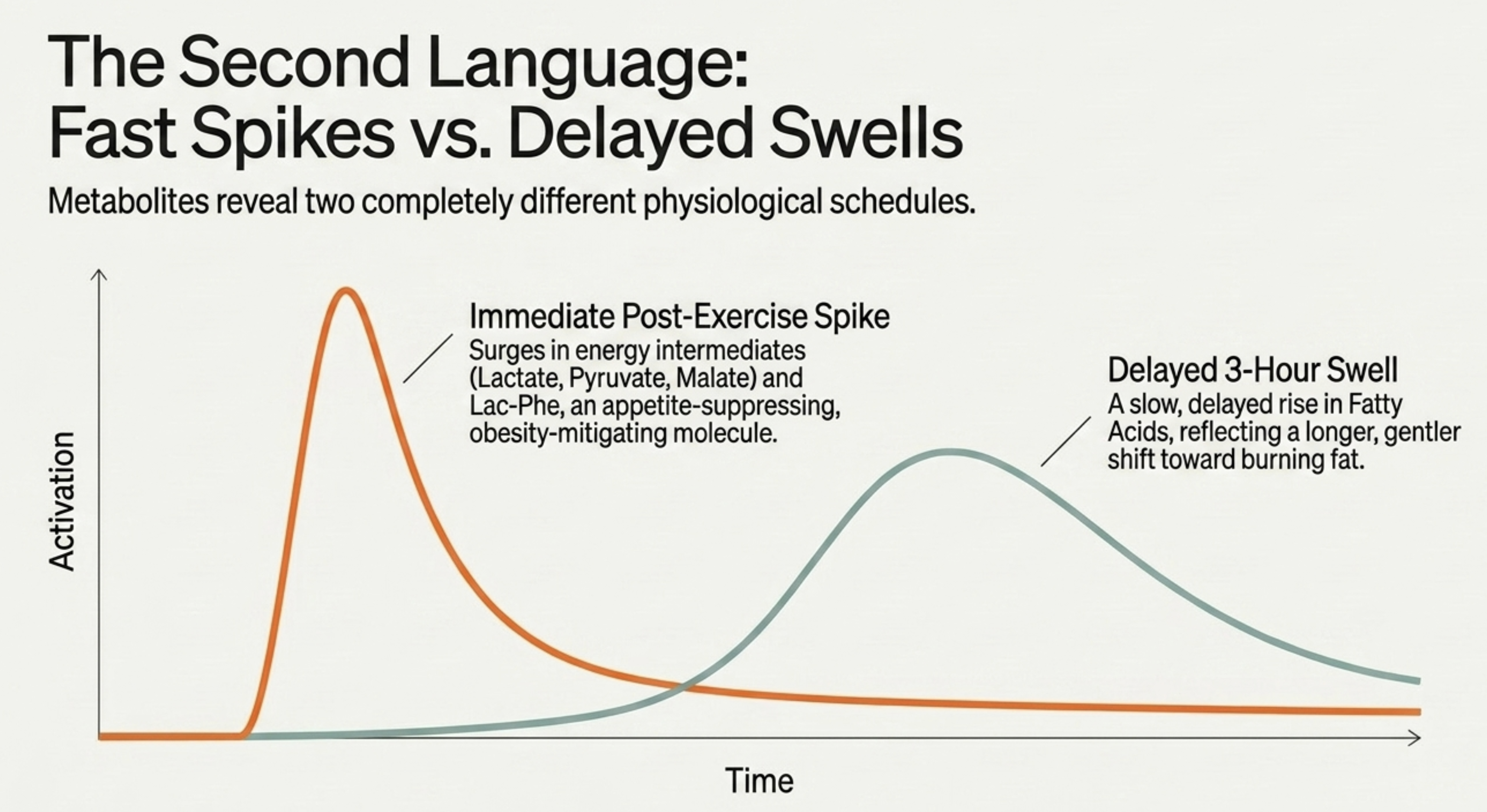
The two languages, proteins and metabolites, thus agree. On both channels, intense exercise produces a large, immediate, coordinated signal, while moderate exercise produces a smaller and more delayed one. Two independent readouts of the blood, telling the same story about intensity. And the convergence sets up the question that gives the whole study its practical weight: not just whether intense exercise signals more loudly, but whether the specific signals it sends are the ones tied to staying healthy.
The Signals That Track With Health
Everything so far establishes that intense exercise produces a bigger, broader molecular response than moderate exercise. But bigger is not automatically better. A flood of signals only matters for health if those particular signals are the ones connected to staying well. This is the question that turns an interesting molecular finding into a potentially important one, and to answer it the researchers reached for a resource that did not exist a few years ago.
They drew on a database built from the blood of 53,026 people, in which thousands of plasma proteins had been measured and then linked, through years of follow-up, to who developed which diseases. This is an enormous map of which circulating proteins track with higher or lower risk of illness across more than a thousand conditions. By cross-referencing the exercise-responsive proteins against this map, the researchers could ask a pointed question: of all the proteins that exercise releases into the blood, how many are ones that, in the general population, are associated with protection from disease?
The answer identified 143 exercise-responsive proteins linked to lower disease risk, spanning fourteen broad categories of illness, with the greatest concentrations in metabolic disease, blood and circulatory conditions. Exercise, in other words, releases into the blood a substantial set of proteins that independently track with being healthier. That alone is a satisfying molecular confirmation of something we already believed about exercise. But the crucial result was how these protective proteins split between the two workouts.
The researchers narrowed to the proteins most specifically protective against the metabolic diseases exercise is most prized for preventing, type 2 diabetes, obesity, and related metabolic disorders. They found 33 such proteins. Of those 33, sprint-interval exercise elevated 32. Moderate-intensity exercise elevated 3. The signals most tightly linked to protection from metabolic disease were, almost without exception, the ones that intense exercise released and moderate exercise largely did not.
This is the finding that gives the study its weight. It is one thing to show that intense exercise produces more signal; it is another to show that the extra signal is disproportionately the protective kind. A few of these proteins showed especially broad and consistent links to lower metabolic risk, and, tellingly, at least two of them have separately been found at higher levels in people who are habitually physically active, hinting that their benefit may extend beyond the minutes right after a workout into a durable feature of a trained body. There was even a thread connecting these proteins to healthy aging: more than a quarter of the metabolically protective proteins were ones whose levels tend to fall with age, including one of the proteins most strongly associated with youthfulness in the blood. The signals intense exercise releases are, to a striking degree, the signals of metabolic health and, perhaps, of a younger physiology.
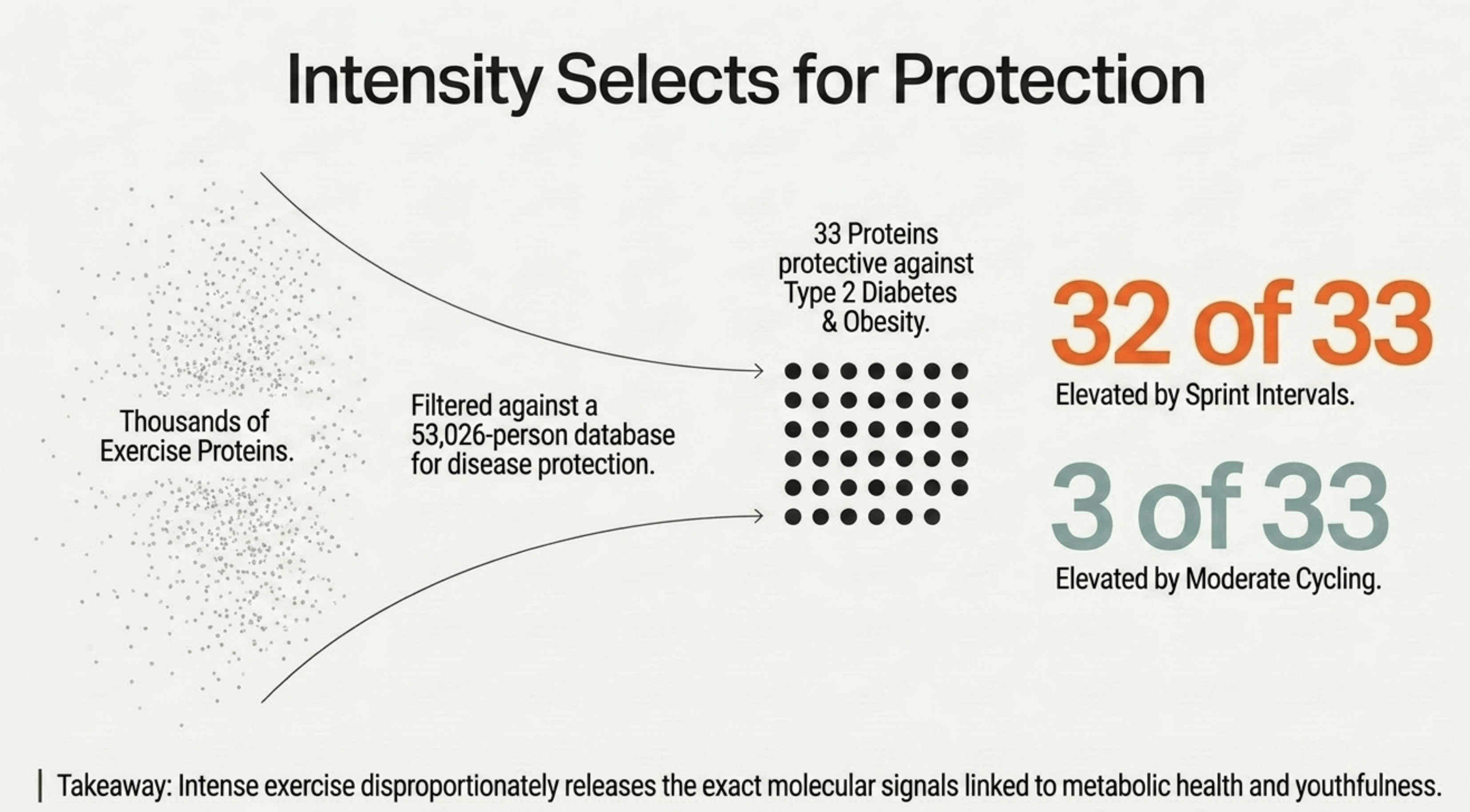
Two honest guardrails belong on this result, and the study respects both. First, these are associations, not proof of cause. That a protein tracks with lower disease risk in a large population does not prove that raising it through exercise will prevent disease in a given person; it makes it plausible and worth pursuing, not certain. Second, the protein-disease links come from a general population database, not from the exercisers in this study, so the chain, intense exercise raises these proteins, and these proteins associate with health, is assembled from two solid pieces rather than demonstrated end to end in one experiment. What the study shows, carefully stated, is that the signals intensity preferentially unlocks are enriched for the ones population data connect to metabolic health. That is a strong and suggestive alignment, and it is not the same as proof that sprinting prevents diabetes.
Even within those limits, the convergence is hard to ignore. The workout that produced the broadest molecular response also produced, specifically, the protective molecular response. Intensity did not just make more noise. It preferentially released the signals that matter.
What Moderate Exercise Does That Sprints Don't
It would be easy to read everything so far as a verdict: intense exercise wins, moderate exercise loses, stop doing the long slow sessions. That reading would be wrong, and the study is careful to head it off. Moderate exercise did not produce a smaller version of the same response. It produced a partly different response, and some of what it uniquely does, intense exercise does not.
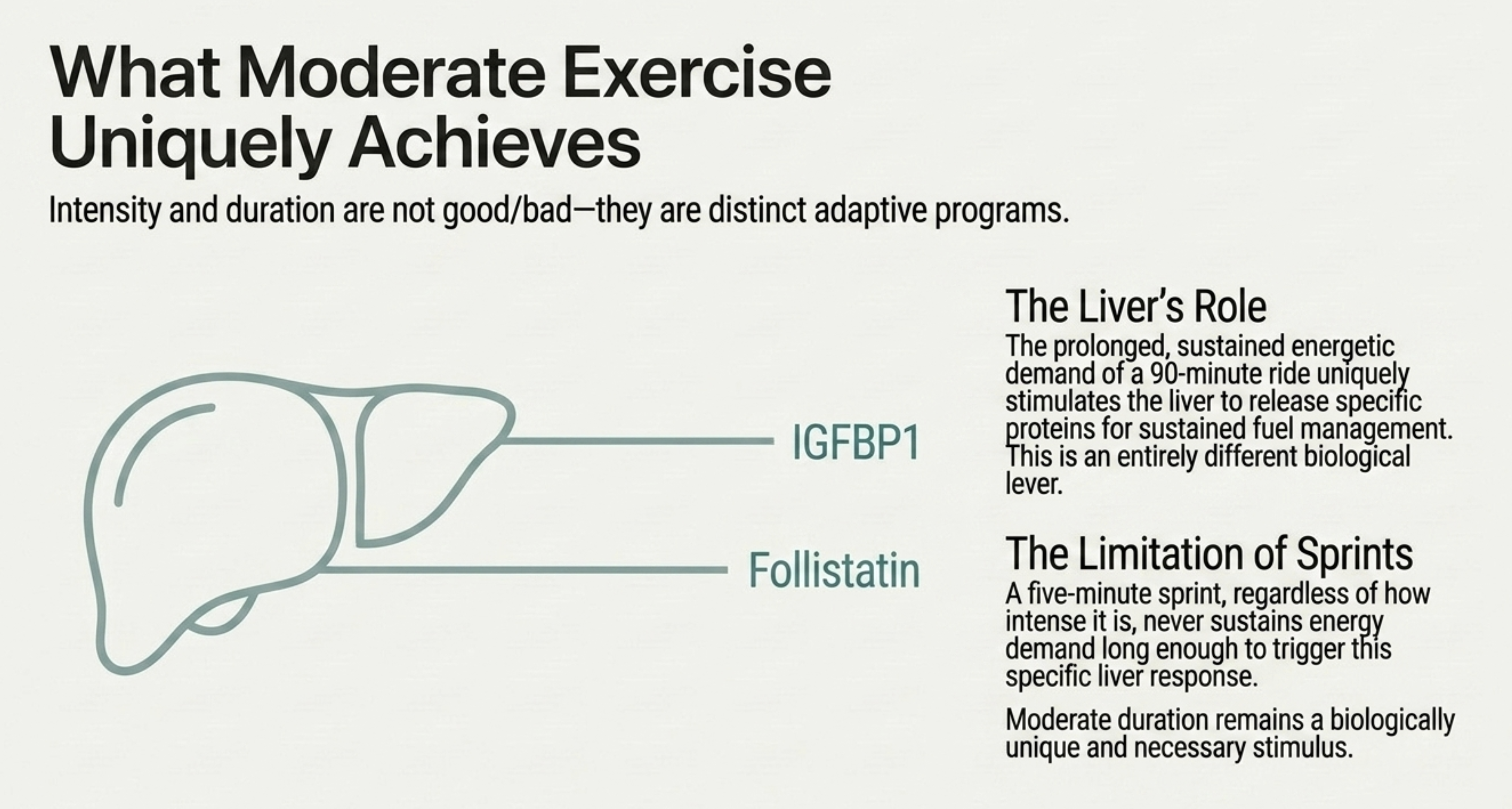
The clearest evidence is in the proteins moderate exercise released exclusively. Two stand out, both from the liver: a protein called IGFBP1 and one called follistatin. These rose specifically after the ninety-minute moderate session and not after sprints, and their appearance makes physiological sense. Sustained, continuous exercise imposes a different kind of demand than brief bursts do. Over ninety minutes, the body steadily depletes its stored carbohydrate, shifts its hormonal balance between insulin and its counter-regulatory hormones, and leans increasingly on the liver to manage fuel. That prolonged demand is what stimulates the liver to release these particular proteins, and a five-minute sprint, however intense, never sustains the demand long enough to do so.
This points to a genuine principle: intensity and duration are different stimuli, and they trigger different adaptive programs. The sharp metabolic stress of sprinting drives one set of signals, largely immediate, broad, and enriched for metabolic protection. The sustained energetic demand of long moderate exercise drives another, slower, more liver-centered, tied to fuel management and the shift toward burning fat. These are not two grades of the same thing on a single scale from worse to better. They are two different tools that reshape the body in overlapping but distinct ways.
There is also a timing dimension the study could not fully untangle, and it says so plainly. Because the moderate session was both less intense and much longer than the sprint session, the study cannot completely separate the effect of low intensity from the effect of long duration. Some of what moderate exercise uniquely produced, the delayed liver proteins, the late rise in fatty acids, may reflect its duration as much as its gentleness. Duration and intensity are braided together in this comparison, and disentangling them fully will take further work. What the study can say is that the two workouts, as real people would actually perform them, produce distinctly different molecular signatures.
For a reader, the honest takeaway is not that one workout is obsolete. It is that intensity is a distinct and underappreciated variable, one that unlocks a broad, protective signaling response that duration alone does not, and that when time is limited, brief intense exercise is a remarkably efficient way to produce that response. Moderate exercise remains valuable, does things sprints cannot, and is far more sustainable and lower-risk for many people, especially those new to training or managing existing conditions. The most complete picture, and the one the biology actually supports, is that the two are complementary. The news here is simply that the intense end of the spectrum turns out to be doing more, and more protective, molecular work than its modest time cost would suggest.
How Far These Findings Reach
This is a rich and carefully done study, but its claims come with real boundaries, and reading it well means holding them clearly.
The cohort was small and mostly male. The core comparisons rested on modest numbers of participants, and they were young, active, metabolically healthy men. This matters because the exercise response is known to differ by sex, age, and health status. Whether the same intensity-dependent flood of protective signals occurs in women, in older adults, or in people who already have metabolic disease, the very people most in need of exercise's benefits, is simply unknown from this study. The findings describe a specific population and cannot be assumed to generalize.
Much of the organ-crosstalk map is prediction, not observation. The tissue-of-origin and tissue-of-destination assignments rest on databases of where proteins are made and where their receptors sit, combined with cell-culture models, rather than on direct tracking of a signal leaving one organ and arriving at another. These are well-reasoned inferences, and the fat-tissue arm was backed by direct experiment, but the broader web of brain, immune, adrenal, gut, and kidney signaling is a predicted map awaiting confirmation. A competing line of research has even found that relatively few muscle-derived proteins reach the general circulation, which suggests some of the secretome may act locally rather than traveling to distant organs.
The cell experiments carry their own caveats. Forcing cultured muscle cells to contract intensely can damage them, and damaged cells leak proteins, which may inflate the counts from the simulated-sprint condition. And plasma washed over cells in a dish is an imperfect stand-in for how signals reach tissue in a living body. The researchers addressed this where they could, most importantly by confirming the fat-cell findings in real biopsied tissue, but the in-vitro numbers should be read as directional evidence rather than precise measurements.
The disease links are associational. The protective-protein findings come from cross-referencing exercise-responsive proteins against a population database in which those proteins track with lower disease risk. This is suggestive, but it cannot prove that raising these proteins through exercise prevents disease. The connection between a protein and an outcome in a large cohort is a correlation, subject to confounding, and the causal step, that exercising to raise these signals actually lowers risk, remains to be demonstrated.
Intensity and duration could not be fully separated. Because the sprint session was brief and the moderate session was long, the study's design cannot cleanly distinguish the effects of high intensity from those of short duration, or of low intensity from long duration. Some of the differences attributed to intensity may owe partly to the contrast in how long each workout lasted. The comparison reflects two realistic workouts, but it is not a clean single-variable experiment.
Finally, this is a study of acute responses. It measured what happens in the hours around a single workout, not the long-term adaptations that accumulate over months and years of training. The reasonable assumption, which the field holds and the training-persistence data here support, is that repeated acute signals build lasting adaptation, but this study observes the pulses, not the cumulative result. It offers a compelling mechanistic account of why intense exercise might be so beneficial, not a long-term outcome trial proving that it is.
None of this undoes the central contribution. The core observation, that exercise intensity dramatically shapes the breadth of the body's molecular response, and that intense exercise preferentially releases signals tied to metabolic health, rests on direct and repeated measurement. But the reach from that observation to "therefore train this way to prevent disease" runs through assumptions the study frames rather than proves, and honesty about the gap is part of taking the science seriously.
The Case for Training Harder, Not Longer
Strip the study to its practical core and two ideas remain, one about how to train and one about how to think about training at all.
The first is that intensity is a lever worth pulling, especially when time is short. The most time-consuming form of exercise in this study produced the smallest molecular response, and the briefest produced the largest and the most protective. For anyone who has believed that the only real exercise is a long session, or who has skipped exercise entirely because ninety minutes was never going to happen, this is genuinely liberating news. A few minutes of hard effort, a handful of all-out intervals, is not a compromise or a lesser substitute. On the molecular measures that may matter most for metabolic health, it did more than an hour and a half of moderate work. When the choice is between a short intense session and nothing because there is no time for the long version, the short intense session is not just better than nothing. It may be better, full stop, on these particular measures.
That said, the honest framing from the counterweight holds. This is not a case for abandoning moderate exercise, which does things intensity does not, carries less injury risk, and is far more sustainable for many people. The real reframe is subtler and more useful: intensity and duration are distinct variables, each unlocking different signals, and a well-built exercise life probably wants both, with intensity deserving more respect than the time it costs would suggest. For the time-pressed, the encouraging specific is that the intensity end delivers a disproportionate share of the protective signaling per minute spent.
The second idea is larger, and it is where this study connects to how we might practice medicine. The whole paper rests on a premise that would have been science fiction a decade ago: that you can draw a tube of blood, measure thousands of proteins in it, and read out the body's physiological state and its trajectory toward health or disease. That is exactly what let the researchers see the difference between two workouts, and exactly what let them link exercise's signals to disease risk through a database of 53,000 people's blood. The protective effects of exercise turned out to be legible as specific, measurable molecules in the circulation.
That legibility is the foundation of a more personal kind of medicine, and it is the premise Healthspan's BioAge+ is built on. The same class of technology this study used to compare workouts, high-dimensional measurement of the proteins and markers circulating in your blood, can be turned on an individual to map where they actually stand: which systems are aging faster, which slower, and how those measures shift in response to the things they change. The exercise signals in this paper are population-level averages; your own physiology is not average. The way to know how your body is actually responding, to intensity, to training, to any intervention, is to measure it, and to track those measurements over time rather than assume. This study is a vivid demonstration that the body's state is written in the blood in remarkable detail. Reading your own is how that science stops being about people in general and starts being about you.
Conclusion: Intensity Is a Language
For decades, the conversation about exercise has run mostly in the currency of time and calories: how many minutes, how far, how much burned. This study suggests a different unit of measure. What exercise does to the body, at least a great deal of it, is send a flood of chemical signals through the blood, instructions passing from working tissues to distant organs, and the richness of that signal turns out to depend less on how long you move than on how hard.
The numbers make the point almost uncomfortably clear. Under five minutes of intense effort moved 714 proteins where ninety minutes of moderate cycling moved 7. It remodeled fat-cell gene activity on a scale of 1,128 genes to 25. And when the signals were matched against the diseases they track with, the protective ones were overwhelmingly the sprint's: 32 of 33 metabolic-protection proteins, against 3. Whatever intense exercise is doing, it is doing it in a language the body appears to read clearly, and it is speaking, disproportionately, the words associated with staying well.
None of this diminishes the long, gentle session, which does its own real work through the liver and the slow shift toward burning fat, and which remains the more sustainable choice for many. The lesson is not that one workout wins. It is that intensity is its own variable, a distinct dialect of the exercise conversation, and that it delivers a strikingly large and protective share of the message for the small amount of time it demands. For anyone whose barrier to exercise has been the clock, that is a genuinely hopeful finding.
But the deepest thing this study offers is not a workout recommendation. It is a demonstration that the body's inner state, its response to stress, its drift toward or away from disease, is now readable in extraordinary detail from a tube of blood. The researchers could see two workouts diverge, could watch fat tissue rewire itself, could connect a molecule released during a sprint to the odds of developing diabetes, all by reading the proteins in the circulation. That legibility is the real frontier. Exercise writes its benefits into your blood in a language we are only beginning to read fluently, and the more clearly we can read it, the more precisely each of us can learn what our own body needs, and whether what we are doing is working.
Related studies